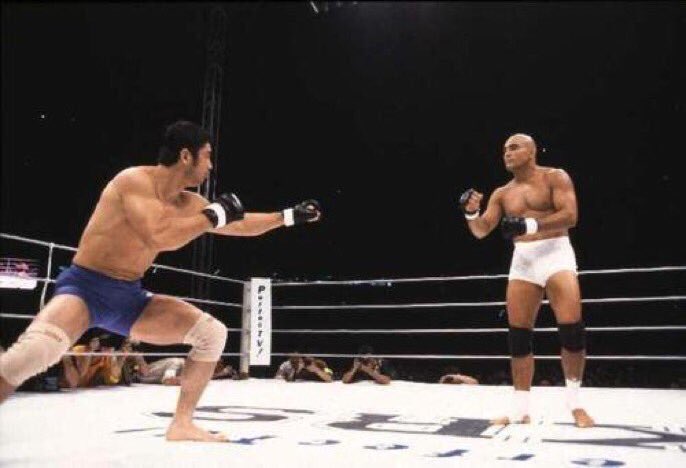
If everything had gone according to the original plan, there would have only been a single Pride Fighting Championships event. Initially, Pride’s first card – held at the legendary Tokyo Dome in front of nearly 50,000 spectators – was intended to be a one-night-only answer to this question: “How would an experienced professional wrestler fare in legitimate combat against one of the world’s most prolific fighters?” The night was a rousing success, though, and the train kept on rolling.
If you watch those earliest events, you’ll not only learn the definitive answer to that question (“not well”) but you’ll also notice a much more slapdash approach when contrasted against Pride’s megacards just a few years later. This makes sense not only compared to the UFC, whose first several events featured the sort of barroom brawlers and dojo toughguys that would quickly disappear once MMA was truly professionalized, and compared to just about any new business trying to get its feet underneath itself.
What did this mean for the earliest Pride events? Fortunately, the template for attracting fans had already been established, and the promotion’s pockets were virtually bottomless, so the first eight Pride cards featured a who’s who of world-class fighters and/or marketable names. It also, however, subjected fans to more than a few amateurish details amid the clashes between stars – but we’ll get to that later.
In this segment, we’ll talk about the highs and lows of Pride’s first events, which established the promotion as a legitimate competitor in the burgeoning MMA space in the late 1990s and blew the market wide open for fighters seeking larger paychecks.
Takada
In the annals of MMA history, Pride 1 will be remembered as the time when Rickson Gracie decisively put to rest the notion that even the toughest professional wrestler could stand a chance in a real fight against a real fighter. Gracie, whose dominance throughout his career was so complete that he was passed over for the first UFC event because the organizers thought he’d make it look too easy, stepped into the Pride ring that October night at age 37, locked an armbar on his opponent in just under five minutes and walked away a decisive winner. In hindsight, the matchup seemed foolish at best and outright irresponsible at worst, but there was a very good reason it was made.
For much of the decade preceding Pride 1, Nobuhiko Takada had established himself as one of the top stars in Japanese professional wrestling. In particular, he founded and performed in the famed Union of Wrestling Forces International promotion, which featured far more realistic in-ring action than most of its competitors. The match results were still pre-determined, but the men who competed in UWFi traded the sorts of punches, kicks, slams and submission holds that suggested they might actually realize success in an unscripted contest.
In an effort to boost the UWFi’s legitimacy among his country’s other popular professional wrestling promotions, Takada began issuing public challenges to Gracie, who himself had come into recent public prominence thanks to his wins at the first two Vale Tudo Japan tournaments. The pot really boiled over when one of Takada’s proteges traveled to California in an attempt to storm the vaunted Gracie dojo and prove that Japanese pro wrestling was a force to be reckoned with.
Gracie made quick, painful work of the unwanted visitor, who returned home looking far worse than when he arrived. While there is no public video footage of the encounter, it has become a well worn factoid in the lore of early MMA as a result of Gracie’s reported brutality. From there, it was only a matter of time before someone put up the money to get Takada, the true UWFi ace, in a ring with the man who at the time was considered the world’s greatest fighter.
And so we arrive at Pride 1.
Anyone who was expecting a competitive matchup – or perhaps even deluded themselves into thinking that Takada would emerge victorious – must have left the Tokyo Dome sorely disheartened. The vast gulf in fighting ability between the undefeated Vale Tudo champion and the superstar pro wrestler was put into sharp focus very quickly, with Takada circling the around the perimeter of the ring while Gracie calmly controlled the middle and waited for his moment to strike. After an aborted takedown attempt thanks to Takada (illegally) grabbing the ropes, Gracie eventually put the wrestler on his back and immediately began raining down punches from the mount position. Soon thereafter, Gracie hyperextended Takada’s arm and captured the win via submission.
The rematch – taking place one year later at Pride 4 – wasn’t much different. Takada’s second effort against Gracie lasted nearly double the time of his first, and he even got a few crowd-pleasing moments of offense. Just like the first fight, though, Takada ultimately found himself tapping out to another Gracie armbar.
Did these two decisive losses prevent Takada from remaining a main-event draw in the early days of Pride? Absolutely not, and his other fights during this time paint a vivid and surreal tapestry of the state of professional MMA in the late ’90s.
Take, for example, his “tune-up” fight between Gracie bouts. At Pride 3, Nobuhiko Takada faced a man named Kyle Sturgeon in an effort to redeem himself from the embarrassment he experienced just a few months earlier. Sturgeon, billed at 6-foot-3 and 224 lbs., was a tattoo-covered MMA newcomer whose only pre-fight media consisted of a single photo of him standing next to the much better known Kimo Leopoldo. He looked a lot like a fighting-game character come to life, and his performance in the ring that night spoke volumes.
If Takada looked a little uncomfortable in the ring during Pride 1, Sturgeon made him look like Demetrious Johnson by comparison. The big American’s manic, bouncing stand-up approach resembled something one might see at 2:00 a.m. in a sloppy parking lot showdown, and while Sturgeon did seem to have some rudimentary kickboxing skills, he was a gigantic competitive step downward for Takada compared to Rickson Gracie.
The fight went like this: First, Sturgeon landed a couple of glancing kicks that Takada sold like he was hit by a car. Then, Sturgeon went for and somehow achieved an awkward takedown that briefly landed him in top position, before he inexplicably stood up without even attempting a strike. With both fighters back on their feet, it was now Takada’s turn to put Sturgeon on his back. After a minute or so without much activity, the pro wrestler suddenly stood up, locked in a heel hook and forced Sturgeon to submit.
At the time, with far less MMA fight footage to judge, perhaps this seemed like a heroic victory for a man who lost so convincingly during Pride’s first event. With the perspective of hindsight, however, it’s pretty easy to see that this contest was anything but legitimate. After this fight, Kyle Sturgeon was never heard from again, and despite an inordinate amount of time spent looking, I haven’t found a single other biographical detail about him that doesn’t involve Pride 3 in all of the vastness of the internet. It’s almost like he materialized out of thin air just to do the job for Takada.
This would not, unfortunately, be the last time a Takada “win” would be marred by controversy. After his second loss to Rickson Gracie at Pride 4, Takada was matched up against the former UFC champion Mark Coleman in what would be Coleman’s Pride debut. On paper, this pairing seemed ridiculous to the point of being potentially threatening to Takada’s long-term health. Coleman might have been on a three-fight losing streak coming into Pride 5, but he was still a 245-pound, pharmaceutically enhanced former NCAA Division I wrestling champion who also competed at the Olympics.
Once again, watching the main event of Pride 5 with the knowledge that it was not entirely on-the-level allows viewers to pick out the handful of strange decisions Coleman makes throughout the course of the fight. He’s easily able to take Takada down and basically do whatever he wants after that, but instead of implementing his trademark ground-and-pound strategy, he opts for a more control-focused offense. Even then, Coleman sacrifices positional dominance on more than one occasion and even gives up on a few submission attempts after what seems like not much effort. It’s akin to watching a basketball player try to shave points without being too obvious – an errant pass here, a forced shot there.
After spending the vast majority of the first round imposing his will, Coleman began the second by once again taking Takada to the mat. This time, though, instead of staying in side control, Coleman first moves into Takada’s guard before standing up and proceeding to punch him in his thighs, all the while keeping his left foot exactly where Takada might be able to grab it.
Like with the Sturgeon fight, Takada miraculously snatches victory from the jaws of defeat via heel hook. Coleman valiantly attempts to fight off the pain, while making very little attempt to actually escape. He gives the referee the ol’ pro wrestling “no – no – no – OK yes I tap” and Takada is once again awarded the victory. In the years since, Coleman has strongly alluded to an arrangement he reached with Pride that incentivized him to perform this way against Takada, and he would soon go on to reach heights never before imagined in MMA thanks to his business savvy.
Takada, on the other hand, would not fare so well. His victory over Coleman was the last of his ten-fight MMA career, though he continued to be matched up against some of the sport’s biggest names well after the word was out that Takada the fighter was far less ferocious than Takada the wrestler. He’d lose quickly to Mark Kerr at Pride 6 – a fight marketed as Kerr seeking vengeance for Coleman’s loss – and from then on was only occasionally brought out for showcase matches against other big draws.
Despite that sub-par record, there’s a reason I’ve opened this series of essays on Pride Fighting Championships by talking about Nobuhiko Takada. Simply put: Without Takada, Pride probably would never have existed. He was never the best fighter at any event where he was featured, but he was by far the most popular. His charisma alone drove thousands and thousands of fans to spend their money to watch him fight, even after most of them knew it was probably an investment in their own disappointment, and his place in the MMA pantheon is set.
Big Daddy & The Old Guard
In order for a mixed martial arts promotion to find success, it must rely on more than the participation from one of Japan’s most popular professional wrestlers. Fortunately, thanks in large part to the regulatory and financial troubles facing the far-less-popular UFC in the late ’90s, Pride Fighting Championships was able to have its pick of the existing crop of the world’s best fighters to fill out its early cards.
Did you know, for example, that the co-main event at Pride 1 was supposed to be an arcade-style slugfest between early UFC stars Tank Abbott and Kimo Leopoldo, or that the headliner at Pride 2 was supposed to feature undefeated UFC multi-tournament champion Royce Gracie against much larger undefeated UFC multi-tournament champion Mark Kerr? Neither of these fights ended up taking place, but the fact that a brand new MMA promotion was immediately able to lure some of the sport’s biggest names across the Pacific speaks volumes to their comparative financial stability.
Instead, Pride 1 featured a snoozer of a 30-minute stalemate between Leopoldo and extremely late replacement Dan Severn, the former UFC champion who was a far more technical but far less exciting competitor than Abbott. This was one of a handful of time-limit draws that took place during these earliest Pride events – before the promotion was compelled to add judges beginning with Pride 5 – and it definitely brought the card’s momentum to a grinding halt.
UFC 7 tournament champion Marco Ruas made a pair of appearances at early Pride events, though at that point he was on the wrong side of 35 and would only fight three more times afterward. Another MMA trailblazer to briefly appear in Pride was former UFC Heavyweight Champion Maurice Smith, who shocked the world two years earlier by handing the seemingly unstoppable Mark Coleman his first professional defeat at UFC 14. Neither Ruas nor Smith would use their time in Pride to springboard to new phases of their careers, but both lent significant credibility to the upstart promotion during its infancy.
On the other side of the age spectrum, 23-year-old Vitor Belfort brought his impressive 6-1 record and UFC pedigree to Japan at Pride 5 after successfully building a name for himself by finishing every single one of his vanquished opponents in the first round. Carlos Newton was a similar up-and-comer who fought on two early Pride cards in addition to his appearances in the UFC, Shooto, the International Fight League and a few other Wikipedia-less promotions during his 14-year career as a grappling wizard and early MMA standout.
And we wouldn’t be talking about the Good Ol’ Days of MMA without mentioning the Gracies. Along with the alpha dog, Rickson, who headlined Pride 1 and Pride 4 against Nobuhiko Takada, two other members of jiu-jitsu’s most famous extended family also plied their trade in front of enthusiastic Japanese audiences during Pride’s earliest era. There was cousin Renzo, who appeared in three of Pride’s first eight events, and Royler, younger brother to Rickson and the first member of the family to suffer an MMA loss.
No discussion of Pride’s initial run of shows is complete, however, without lending significant attention to one man who not only helped put the UFC on the map – for better or for worse – but also appeared in six of the first eight Pride FC events. While this fighter would never hold a UFC or Pride championship belt, he quickly established himself as an action-first presence wherever he competed and thus endeared himself to fans in a way that few others have achieved since. Of course, I’m talking about Gary “Big Daddy” Goodridge.
An arm-wrestler, welder and amateur boxer, Goodridge traveled to Puerto Rico for UFC 8, where he gave both fans and critics one of the sport’s most memorable highlights in his very first fight. After Goodridge’s opponent closed the distance to attempt a takedown, the 6-foot-3, 240-pound Canadian maneuvered him into a crucifix position – trapping both of his opponent’s arms and leaving his head completely unprotected – and proceeded to elbow him into oblivion. Nearly 30 years later, it remains among the most violent finishes in UFC history.
Goodridge would go on to compile a 3-4 record in his earliest UFC fights, then traveled to Brazil for the first International Vale Tudo Championship, an eight-man tournament with virtually no rules. After muscling his way through his first two opponents in less than two minutes combined, he captured the first IVC title after capturing Pedro “The Pedro” Otavio’s testicles in his mighty grasp and squeezing hard. No one ever confused Goodridge for a technician, but his methods generally proved effective in those early days.
When Goodridge found himself on that fabled flagship Pride card in 1997, then, it was with the expectation that he would provide the sort of explosive performance fans had grown so accustomed to seeing, and Big Daddy did not disappoint. Facing fellow UFC veteran Oleg Taktarov in the evening’s second fight, Goodridge successfully avoided the Russian’s formidable grappling and ended up landing a punch that put the UFC 6 tournament champion into a deep, face-planted slumber.
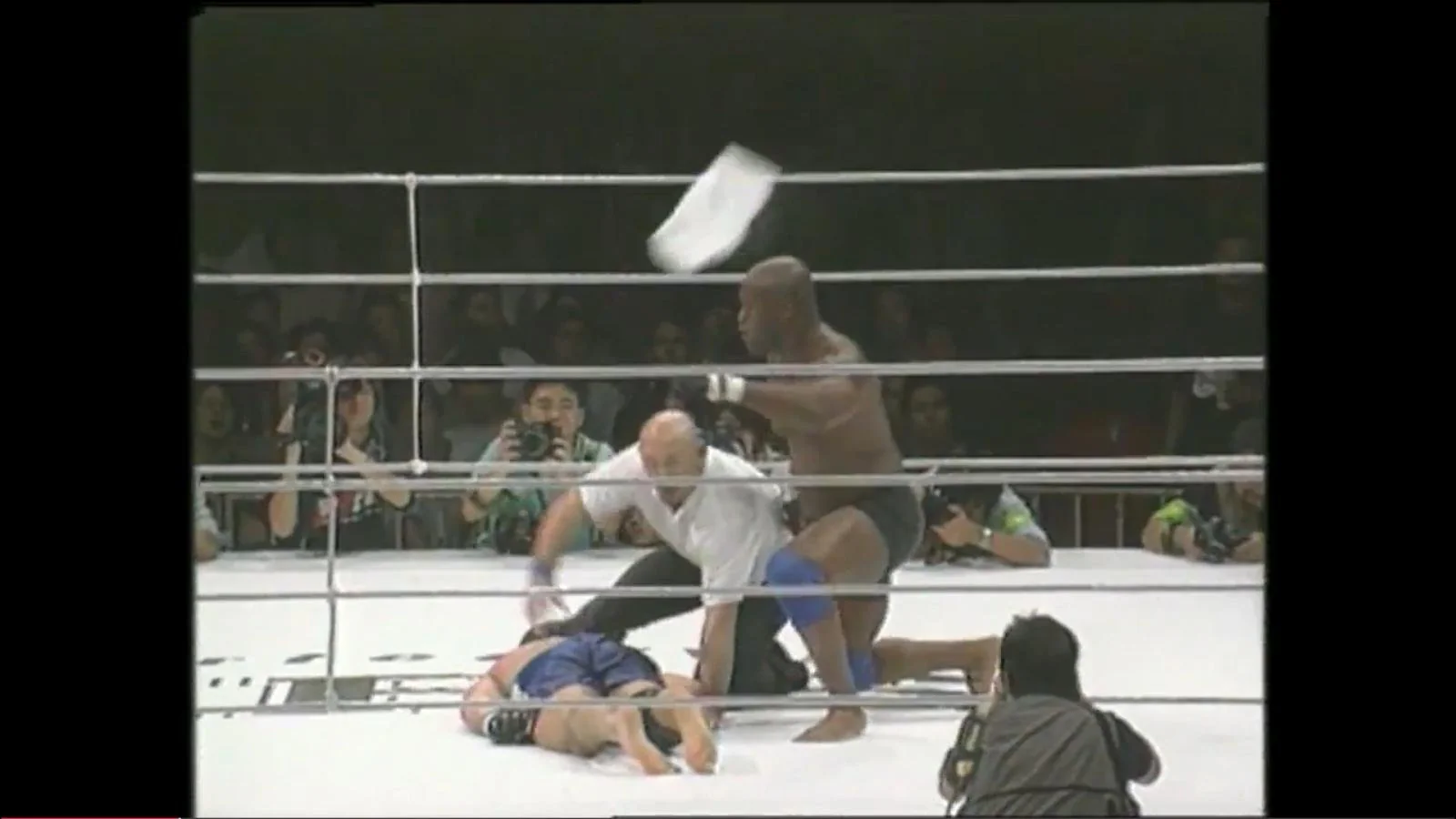
Goodridge would alternate wins and losses between Pride 1 and Pride 4, before dropping five of his next six fights for the promotion. While he was still a welcome presence on any fight card throughout the late ’90s and early 2000s – appearing a grand total of 19 times in Pride Fighting Championships alone – it was becoming ever more clear that Big Daddy would likely never find himself counted among the sport’s elite.
Perhaps the less said about Goodridge’s later career, the better. Like so many fighters of his and any era, he stuck around longer than he probably should have, chasing a paycheck and another chance to hear a room full of fans cheer when he stepped through the curtain, and in 2012 he was diagnosed with early onset dementia as a result of his chosen profession.
During his heyday, though, Gary Goodridge was a true fan-favorite. No matter the stakes, he always showed up ready to compete and determined to win. While other fighters that were part of the earliest Pride Fighting events might have carried better records or more prestigious resumes, few in the history of mixed martial arts could match Big Daddy’s almost universal appeal among the people in the stands.
Ice Cold
With a new fight promotion comes new fighters, and along with the professional wrestling and UFC mainstays Pride was able to attract to its ring, it also seized on an opportunity to showcase talented athletes who until then had received considerably less attention from MMA fans. Many of these men would become regular Pride competitors throughout their careers, while others appeared for an event or two and then vanished from the sport. A few, however, would use their success in Pride’s earliest days to earn a steady – if dangerous – paycheck for the next decade-plus.
Without question, the fighter who exemplifies Pride’s ability to create a household name out of a virtual nobody is Kazushi Sakuraba. He’ll receive his due in an extended piece later in this series, but for now we’ll sum up his contribution thusly: Sakuraba was the biggest home-grown star Pride Fighting Championships ever produced. He fought 16 times between 1998 and 2001, losing just three of those contests, and continued to be a top Pride attraction nearly throughout its entire run as a promotion. While he never held a title belt, he was without a doubt the People’s Champion in Pride FC.
One of the few men to defeat Sakuraba in those early days was fellow up-and-comer Igor Vovchanchyn, who drove Saku to the point of literal exhaustion during their semifinal match in the first Pride Grand Prix tournament and compelled his corner to throw in the towel. That would have been slightly more of a surprise, even despite Sakuraba’s stature in MMA at the time, if Vovchanchyn was as new to the sport as so many others competing on Pride’s early cards. On the contrary, by the time the Ukrainian kickboxer met the Japanese wrestler that night in 2000, he was one of the most experienced fighters in the entire promotion.
When Vovchanchyn arrived in Japan in 1998 for Pride 4, he already carried with him a 31-2 record in professional mixed martial arts/vale tudo/no holds barred fighting, and had won seven grueling single-night tournaments. At 5-foot-8 and 235 lbs., he was built like a fire hydrant with lethal striking skills, and quickly impressed both fans and Pride executives alike with an impressive win over the aforementioned – and much larger – Gary “Big Daddy” Goodridge. From there, he notched a pair of decisions at Pride 5 and Pride 6 while also finishing four other opponents during interceding events in Brazil and Ukraine. It would be Vovchanchyn’s performance at Pride 7, however, that really made people start to take notice.
No one gave Vovchanchyn much of a chance when he was matched against Mark Kerr in Sept. 1999, and why would they? Kerr was at least seven inches taller, 20 lbs. heavier and was coming into the fight with an unblemished 11-0 record. At the time, Kerr was widely considered the best fighter in the world, and if I would have been making odds for his bout with Vovchanchyn, Kerr would have started at like +450.
What happened next, then, took just about everyone by surprise.
Instead of bulldozing his way into a takedown like he did to begin so many of his previous wins, Kerr briefly chose to stand and trade with Vovchanchyn in the opening minutes of their fight at Pride 7. This decision would quickly prove costly when Vovchanchyn landed a solid straight punch that moved Kerr backwards and made him rethink his strategy.
In a strange way, this was one of the most important moments in the brief history of MMA up to that point. With that single punch, Vovchanchyn not only hurt his opponent physically, but shattered the illusion of invincibility that had developed around Mark Kerr since he broke into professional fighting, and Kerr would never be the same after that.
The first ten-minute round ended without much other significant action, with Kerr mostly hanging out in Vovchanchyn’s guard, and the American wrestler opted to go back to his grappling-centric strategy for round two as he scored a quick takedown. At that point in the fight, however, Kerr had pretty much run out of gas, and Vovchanchyn was able to disengage from his exhausted opponent’s usually smothering top-position offense.
While Kerr was quickly able to reestablish himself in Vovchanchyn’s guard after the kickboxer’s first escape, Vovchanchyn would immediately follow up his second escape with a vicious knee directly to Kerr’s face. Kerr turtled up, with his hands and knees on the mat (a key detail for later) and Vovchanchyn landed two additional knees to the top of Kerr’s head before the referee stopped the fight.
Vovchanchyn was elated. He had just stepped in the ring with the most dangerous fighter in the world and he’d kneed him into submission, thus establishing himself as the new king of the MMA ring. Only things weren’t quite so simple.
Between Pride 6 and Pride 7, the promotion changed the rules such that knees to the head of a grounded, face-down opponent – the position Kerr was in when Vovchanchyn delivered his final blows – were no longer legal. Kerr appealed to Pride’s governors and the fight was quickly ruled a No Contest. Unlike with other more egregious examples of foul play in the ring, Vovchanchyn’s illegal strikes stemmed from either a misunderstanding of the rules or an adrenaline-fueled reaction based on how all previous Pride events had been regulated.
In the eyes of many fight fans, though, Vovchanchyn’s performance was enough to firmly establish himself as one of MMA’s elite, regardless of the official result, and the next several years of his career would do little to change things. He won his next four fights en route to an appearance in the finals of the Pride 2000 Grand Prix Tournament, then went 8-2 in his next ten contests, including a decision win over Kerr in their rematch at Pride 12.
Vovchanchyn would continue to compete until 2005, compiling a total professional record of 56-10 along with the one No Contest, and went unbeaten in 40 fights between 1996 and 2000. While other fighters would establish or expand their popularity through their exploits in Pride, few others who were neither professional wrestlers nor UFC veterans made as strong an impact.
The Smashing Machine, Part I
The year is 2003 and I’m wandering through a video store alone.
Back in high school, I spent a lot of weekend nights in my parents’ basement watching movies I was sure no one else wanted to see, and this particular Friday would be no different as I circled back to the New Release section for the third time.
I passed by the dozen or so copies of Stealing Harvard, The Ring and Knockaround Guys on the shelves, when a single DVD cover caught my eye. On it, a bruised and bloodied man looks downward toward a title that was impossible to ignore: The Smashing Machine: The Life and Times of Extreme Fighter Mark Kerr. I didn’t hesitate for a second before scooping the film’s box from the shelf and bringing it to the checkout desk, especially when I noticed that it was an official selection for the inaugural Tribeca Film Festival, and what I saw on the television screen later that night would change my perception of martial arts forever.
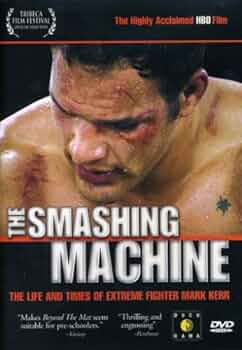
Before watching The Smashing Machine, I was sure that every “extreme fighter,” as MMA athletes were then commonly known, was a bloodthirsty psychopath who made a little extra pocket money by stepping into a cage and head-butting some other beer-gutted brawler into oblivion. For the most part, the marketing for the UFC and other lesser promotions around the turn of the century was laser-focused on the sport’s most stomach-turning aspects, and I remember more than one late-night commercial advertising “cage fighting’s bloodiest wars” that almost exclusively showed undefended stomps. The Smashing Machine‘s opening moments certainly highlighted the very real bodily danger involved in MMA competition, but within just a few minutes I realized that my preconceived notions about its central figure could not have been more misguided.
Instead of a gruff, monosyllabic brute, Mark Kerr is a soft-spoken, articulate professional. He’s a college graduate and a former NCAA Division I wrestling national champion. When he explains to an incredulous middle-aged woman in a medical center’s waiting room that no, he actually doesn’t hate the other men he fights because mixed martial arts is just a sport like football or hockey, he changed not only that woman’s view but mine as well. Still, when Kerr was at the top of his game, he was among the most dominant and violent fighters in the world.
To put a finer point on it, only one of Mark Kerr’s first seven pre-Pride MMA fights lasted longer than two-and-a-half minutes. During his professional debut – where he defeated three other men in a single evening – his second opponent was disqualified for literally crawling out of the ring to avoid taking additional punishment. All four of Kerr’s UFC fights – spread over two single-night tournaments in 1997 – ended with quick stoppages, and with Pride expanding its roster it was a match made in heaven when he made his way to Japan.
Kerr’s first appearance in Pride was supposed to be opposite Royce Gracie in what would have been a matchup between two undefeated former multi-time UFC tournament champions. Gracie vs. Kerr would have had no time limits and no referee stoppages, guaranteeing fans around the world a result that would unquestionably determine the world’s best fighter.
Alas, the match would never take place. After the posters for Pride 2 had been created, Gracie suffered a back injury and would be forced to withdraw from the fight that would have pitted him against a muscled-out world-class grappler that would step into the ring outweighing him by 75 lbs. and would be an enormous betting favorite for anyone who followed the sport closely.
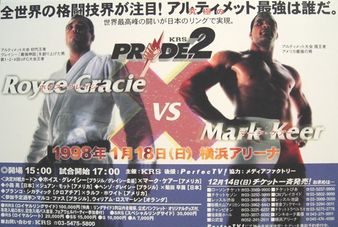
Kerr would instead make his Pride debut against Branko Cikatic, a former K-1 World Grand Prix champion and by far the most experienced and dangerous striker Kerr had faced to that point in his career. Unfortunately, what could have been an entertaining matchup between two of their respective disciplines’ top practitioners quickly soured into a main event that Pride’s promoters would rather forget.
It was clear from the outset that Kerr wanted no part of a standup exchange with one of the world’s best kickboxers, and quickly moved in on Cikatic for a takedown – and that’s when everything went to hell. Cikatic’s response to Kerr’s takedown attempt was to hit a Pride foul trifecta by a.) repeatedly elbowing Kerr b.) in the back of the head while c.) holding onto the top rope in a feeble attempt to stay on his feet. The referee quickly stepped in to restore order and re-explain the rules to both fighters, giving Cikatic the benefit of the doubt that perhaps his instincts just kicked in after being gripped up by someone the size of Mark Kerr.
The match restarts and Kerr once again maneuvers for a takedown – and Cikatic does the exact same thing. At this point, Kerr seems to think “well if this guy isn’t going to follow the rules then neither am I” and just starts wailing on Cikatic as multiple Pride officials try in vain to restrain a man with the musculature of an NFL edge rusher. Cikatic eventually falls to the mat, and Kerr ends the melee – and Pride 2 as a whole – with a kick directly to his opponent’s head. The official result was a win for Kerr by disqualification, but if the fight would have been allowed to continue it would only have been a matter of time before Cikatic quit or was put to sleep.
Kerr’s next three fights in Pride – all wins, all by stoppage – did little to diminish his reputation as the most dominant figure in MMA. He defeated the aforementioned Pedro Otavio after catching him in an armlock and eliciting the sort of noise The Pedro hadn’t made since Gary Goodridge grabbed hold of his private parts, then wore out Hugo Duarte in a three-round slog that ended when Duarte laid face-down on the mat and refused to fight. Kerr made unsurprising quick work of Nobuhiko Takada and was ready to continue cementing his legacy against an undersized and unheralded Ukrainian kickboxer named Igor Vovchanchyn.
Mark Kerr was on top of the MMA world and seemed unbeatable between the bells. Outside the ring, however, the story was much different. What few people knew – and what The Smashing Machine revealed in all of its ugliness – was that while Kerr was making mincemeat of the men unlucky enough to face him, he was a full-blast drug addict. We’re talking multiple-drawers-full-of-painkiller-vials-and-syringes drug dependency. One of the documentary’s earliest scenes shows an exhausted Kerr backstage after the No Contest against Vovchanchyn, trying with increasing frustration to communicate his desire for some injectable opioids to a Pride official whose first language is Japanese.
One month later, in the film’s most heart-wrenching sequence, Kerr lands in the hospital after an accidental overdose. He’s visited by two of his teammates from his Syracuse wrestling days, who show that even the toughest ex-college athletes aren’t immune to breaking down when their friends are in trouble. At this point, it’s increasingly apparent that Kerr’s fighting career has taken a backseat to his addiction, and his status as the world’s best fighter has never been more tenuous.
You Don’t See That Anymore
When the UFC began in 1993, it advertised itself as an event with “no rules.” While this bold claim wasn’t technically true – even the promotion’s earliest events prohibited biting and eye-gouging – all of the official bylaws could be summed up in just a few sentences. As time has passed, and especially as the UFC actively sought to have mixed martial arts sanctioned and regulated around the world, MMA’s rules have become more extensive and specific, but those earliest events definitely featured some things that would shock modern MMA fans.
The same could definitely be said for Pride’s first several cards. While the promotion would eventually establish a consistent ruleset that resulted in some of the most exciting fights in history, it took a few years and some experimentation to get there. In fact, the very first contest in Pride 1 featured an idiosyncrasy that would immediately identify it as an event held in MMA’s early days: The Shirt-On Fighter.
While Kazunari Murakami could, from an ring-attire and physique standpoint, time-travel to today and blend right in with any modern promotion’s roster, John Dixson was the sort of proto-MMA superheavyweight who looked a lot more like competitive eater Eric “Badlands” Booker than like multi-division UFC champion Jon Jones. Hiding his prolific midsection underneath a sleeveless t-shirt, Dixson briefly held his own against Murakami, even landing a takedown and momentarily maintaining top control. Murakami quickly turned the tables, however, returning to his feet and then effortlessly judo-throwing the much bigger Dixson to the mat. From there, Murakami maneuvered for an armbar which ended the fight. Dixson would continue to compete in regional promotions for the next decade, but would in many ways serve as the avatar for fighters whose best days in MMA were already in the past by the time 1997 rolled around. Pride FC would certainly showcase its fair share of fighters who in no way resemble what we now think of when we envision a mixed martial arts professional, but nothing said “early MMA” quite like seeing a man compete while wearing a shirt.
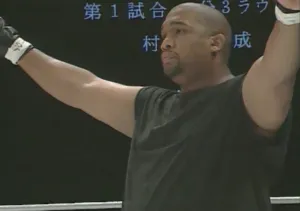
While I’d love to say that we definitely don’t see fixed fights in the same clumsy way that Pride fans occasionally experienced, if you have enough interest in MMA to have read this far, I think we probably agree that not every contest is entirely on the level. That being said, I’d prefer even a fixed fight to some of the downright boring presentations from Pride FC’s earliest cards. Perhaps due to Pride’s significant appeal among Japanese professional wrestling fans, spectators in the late ’90s had a larger appetite for extended grappling sessions than I do, but the first four events featured number of fights that exceeded 30 minutes in length only to end in a time-limit draw or a sudden submission by a member of the Gracie Family on an exhausted opponent. While these matchups are certainly admirable displays of toughness and stamina, it’s probably no coincidence that judges’ decisions were introduced at Pride 5 after a half-dozen or so marathons on the mat.
One other slightly more subtle difference that attentive viewers might notice when re-watching early Pride Fighting cards on the UFC’s streaming service is that the English-language play-by-play was clearly recorded well after the fights themselves took place. Because of the American public’s general distaste for MMA in the late ’90s, the first nine Pride events were only broadcast live in Japan, leaving an auditory void when the promotion later wished to distribute DVDs of its events stateside. For my money, there’s no better two-man MMA commentary team than that initial Pride pairing of “The Fight Professor” Stephen Quadros and former UFC champion “El Guapo” Bas Rutten, and their combined expertise makes Pride FC 1-8 much more entertaining to watch. Occasionally, however, they do tip their hands.
Perhaps the most obvious example takes place at Pride 3, when Gary Goodridge squared off against Amir Rahnavardi, a kickboxer making his professional debut who also happens to be one of Rutten’s training partners. Just as the fight begins, Rutten lets slip that Rahnavardi contacted him at some point between the day the fight took place and the day “El Guapo” went into the voiceover booth to let him know that Goodridge won, thus giving away the result of the fight as it’s taking place. Does anyone watching Pride 3 all these years later really care about how Goodridge vs. Rahnavardi ends? Probably not, but in an age of decidedly more polished play-by-play, listening to Quadros and Rutten have some fun while watching fights they’d already seen harkens back to MMA’s simpler days.
What Could Have Been: Frank Shamrock/Gary Albright
Pride FC operated under the assumption that if the promoters paid fighters enough money and attracted enough fans, it would almost immediately eclipse its competitors and establish itself as the single best place to watch mixed martial arts. It’s hard to argue against the logic behind that plan, at least on a short-term basis, and Pride was very successful in quickly building its reputation in the late ’90s. Despite that rapid growth, Pride still existed as one of a handful of premier promotions during its decade-long run, and there were plenty of world-class athletes who would never step into its ring. To close out each segment of this collection, we’ll meet some of those people who never appeared in Pride FC and speculate wildly about how they might have performed.
The most obvious choice when talking about MMA from 1997 to 1999 is Frank Shamrock, who first established himself as a competitive presence by following his adopted brother Ken’s path to Pancrase. Under that very specific ruleset, the younger Shamrock went 11-6-1, but finished his Pancrase run in 1996 on a two-fight losing skid and then dropped a one-round, 30-minute decision at SuperBrawl 3 in his American debut. Just a few months later, though, Shamrock would emerge as one of the best pound-for-pound fighters in the world. In Sept. 1997, he began an unbeaten streak that would last more than eight years, during which he would capture the first UFC light heavyweight title and defend it four times. He was named Fighter of the Year multiple times by the few publications that covered MMA a quarter-century ago and was generally considered to be among the very best in the business.
There are, however, a couple of challenges when trying to shoehorn Frank Shamrock into hypothetical Pride FC events. For starters, despite his pedigree as a UFC light heavyweight champion, Shamrock was always undersized for the division, sometimes being outweighed by more than 20 lbs. in the octagon. While Shamrock vs. Royce Gracie or Shamrock vs. Kazushi Sakuraba would have been dream fights, one wonders how he would have fared in Pride’s openweight era against the promotion’s giants like Mark Kerr, Mark Coleman and Tom Erickson or even fighters a little closer to his size like Wanderlei Silva and Igor Vovchanchyn. This is especially true when one factors in the ability for Pride’s competitors to knee and kick their grounded opponents in the head, as Shamrock’s preference was always to take things to the mat.
Instead, there’s another athlete who would have been both a tremendous draw and a potential champion if Pride FC had come along just a few years sooner. Picture, if you will, a 6-foot-4, 350 lb. behemoth who was not only larger than most of his opponents, but possessed the sort of legitimate combat skills that earned him second place in the NCAA Division I national wrestling championships. This is a man who could have transitioned immediately into MMA after college and, after adding some striking to his arsenal, would have been a sight to behold taking on the the sport’s best and biggest. But that’s not even the most fun part.
In the decades before mixed martial arts was considered a legitimate next step in the lives of collegiate or Olympic heavyweight grapplers, many of these giants decided to ply their trade in a slightly different way: by becoming professional wrestlers. This is where Gary Albright found himself in the late 1980s after finishing a very successful amateur career at the University of Nebraska. Albright would cut his teeth with the legendary Stampede Wrestling in Canada, but didn’t become a real star until he traveled to Japan in 1991 to become part of a brand new promotion.
Unlike most organizations, the Union of Wrestling Forces International promised to bring fans the most realistic presentation they’d ever seen. Instead of the staid routine of back-and-forth offense followed by a signature move leading to a pinfall, UWFi developed a unique format that created an environment much more akin to a martial arts competition than a professional wrestling show. Each competitor in a match began with 15 points, and would lose points each time they were knocked down, placed in a disadvantageous grappling position or used the ring ropes to force their opponent to break a hold. A winner would be declared only when one wrestler submitted, lost all of his points or was knocked down for a full boxing-style ten-count.
In Albright, the UWFi stumbled upon the sort of gaijin monster that would not only bring a credible combat resume to its roster but could instantly draw the sort of money usually reserved for a company’s biggest stars. He blitzed his way through his first several matches, knocking his opponents out with slams so furious that he was given the nickname “Master of Suplex,” and eventually he was paired against UWFi’s ace – a man named Nobuhiko Takada.
Between May 1992 and Nov. 1994, Albright and Takada split a quartet of singles matches in UWFi and along with Super Vader (a.k.a. Big Van Vader) formed a trio of bankable names around which the promotion focused the majority of its major events. While Takada’s reigns as UWFi champion would burnish his image as someone who might actually be able to hold his own in a fight where the outcome was not predetermined, Albright would exit the shoot-style promotion for the more traditional confines of All Japan Pro Wrestling, so fans never got to see what would surely have been a much anticipated rubber match between the two superstars. What better place for that showdown to happen than in Pride Fighting Championships?
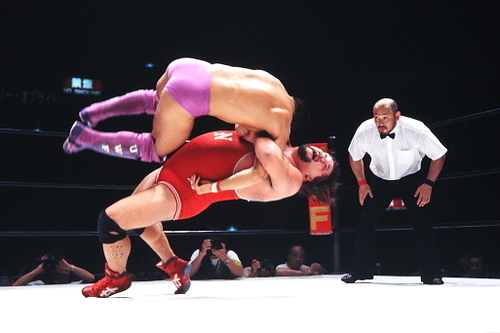
As appealing as the fight would have seemed on paper – it would have surely drawn a massive crowd and captured the attention of all Japanese wrestling and combat sports aficionados – does anyone really think it would have been more competitive than when Takada faced Rickson Gracie? As fans saw in Pride 1 and Pride 4, Takada withered under the pressure of true competition, losing quickly to Gracie even though he outweighed his Brazilian opponent by 25 lbs. Against Albright, Takada would be the much smaller man, giving up more than 100 lbs. to the former NCAA heavyweight runner-up. As much as Takada might have ruled the world of performance fighting, the minute Albright got his hands on him without the limitations of a script, Takada would have been folded in half and then pummeled into oblivion.
From there, Albright would have been the perfect fighter to place at the top of Pride’s early cards. Fights against Kerr and Coleman would have put Albright’s grappling acumen to the test, and even guys like Gary Goodridge or Emmanuel Yarborough would have made for entertaining opponents. How long Albright would have lasted in the world of MMA is a real question, though. Even if he would have debuted with the rest of the Pride cohort in Oct. 1997, he would have already been 34 years old – just one year older than Coleman, who was very much considered past his prime by the time he made his way to Japan.
The other concern, of course, surrounds Albright’s physical health. In early 2000, Albright collapsed in the ring in the middle of a pro wrestling match and was pronounced dead shortly afterward. At just 36 years old, Albright suffered from an enlarged heart and blocked coronary arteries, so the cardiovascular exertion required in MMA might have been too much for his body to handle. Nevertheless, watching the Master of Suplex ragdoll his opponents around the Pride ring would have been a sight to behold, and would have undoubtedly had the typically subdued Japanese audience roaring with happiness.
Recommended Fights:
Nobuhiko Takada vs. Rickson Gracie – Pride 1
Gary Goodridge vs. Oleg Taktarov – Pride 1
Mark Kerr vs. Branko Cikatic – Pride 2
Nobuhiko Takada vs. Kyle Sturgeon – Pride 3
Nobuhiko Takada vs. Mark Coleman – Pride 5
Mark Kerr vs. Igor Vovchanchyn – Pride 7

